Virginia’s proposed cannabis law would give a licensing advantage to some applicants from Southwest and Southside

Today we’re going to get down into the weeds.
Our topic: the bill to legalize weed sales in Virginia, more properly cannabis or what we used to call marijuana before cannabis became the preferred term.
We’ve known the outlines of this bill since December — most notably that there would be no “opt out” clause. Instead, cannabis sales will be legal in every county and city, assuming there’s a licensed operator there. Some key details were still being worked out, though.
Now Del. Paul Krizek, D-Fairfax County and chair of the Joint Commission to Oversee the Transition of the Commonwealth into a Cannabis Retail Market, has introduced the bill — HB 642 for those of you following along from home — and we can finally get a look at the specifics. Yes, he missed an opportunity to get this filed as HB 420, but that went to a bill about when rate increase proceedings involving public utilities may be reopened, by Del. Nicole Cole, D-Spotsylvania County.
On the Senate side, the bill is SB 542 by the commission’s vice chair, Sen. Lashrecse Aird, D-Petersburg, although in a committee meeting last week it was merged with a rival bill from Sen. Aaron Rouse, D-Virginia Beach, so now is somewhat different from the House version. One immediate difference: The House bill would allow retail sales starting Nov. 1, 2026, the Senate bill not until Jan. 1, 2027. The difference between those could make a difference in what your Thanksgiving and Christmas celebrations are like this year.
The criteria for licenses would benefit applicants from Southwest and Southside
We have known all along that there would be some “social equity” component to how licenses are awarded; that’s one of the things that most concerns many Republicans, some of whom would otherwise be comfortable with legalizing retail sales. Some, but not all, licenses would go to what the bill refers to as “impact license applicants.” The bill sets out seven criteria; to qualify for preference in licensing an applicant must check off at least four of those boxes. The criteria that upset Republicans most are the ones that put a premium on being convicted of marijuana-related offenses. Democrats see these provisions as recompense for those who have been busted for something that’s now legal; Republicans see it as rewarding lawbreakers and disadvantaging applicants who have followed the law.
Some of the provisions of the social equity provision in the bill — 4.1-606, Section B13 if you want to look it up — likely would benefit some Black Virginians. However, others would give an advantage to applicants from predominantly white counties in Southwest and Southside Virginia.
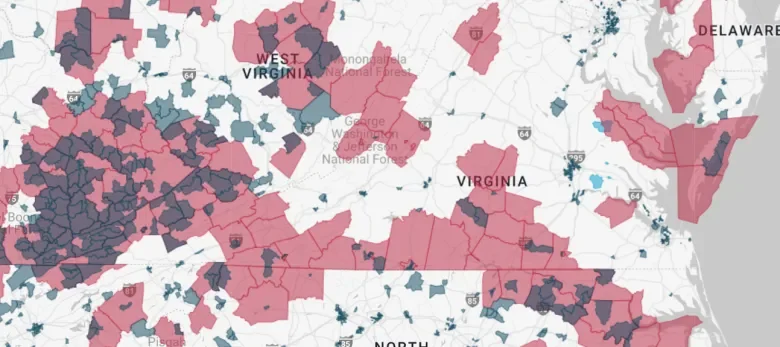
These are the parts of Virginia that qualify. The areas in red are qualifying localities, the ones in gray are qualifying census tracts (sometimes they overlap) and the ones in blue are qualifying Native American areas. Source: U.S. Small Business Administration.
The places in red (entire counties), gray (census tracts) and blue (tribal lands) are all HUB Zones. That means anyone who lives there or went to school there for the required amounts of time qualifies under the social equity component. If you went to school there and live there now, that’s two of the required four boxes you can check off immediately. If you went to college on a Pell Grant, or went to a college with a lot of Pell Grant students, or served in the military, or have received a U.S. Department of Agriculture loan as a distressed farmer, you can get to the four-box threshold without having a single weed conviction on your record.
Zoning restrictions limited to 1,000 feet
As expected, the bill gives localities the power to keep cannabis stores 1,000 feet away from “any place of religious worship; hospital; public, private, or parochial school or institution of higher education; public or private playground or other similar recreational facility; child day program; substance use disorder treatment facility; or federal, state, or local government-operated facility.” Localities can allow stores to be closer, but it can’t go beyond that 1,000 feet limit.
The number of licenses could increase after 2028
The bill sets the initial number of retail licenses at 350 — for comparison, Virginia has 402 Alcohol Beverage Control board stores. After Jan. 1, 2028, the board could increase that number, with this proviso: “If the Board makes an additional number of those licenses available, the number of licenses available to impact licensee applicants shall be equal to or greater than the number of licenses available to all other applicants.” That means Boones Mill may not have been premature in holding a hearing recently on what people would like to see in a zoning ordinance.